


Differential reinforcement is one of the most versatile tools in the ABA practitioner's toolkit. Whether you are reducing challenging behavior, building new skills, or shaping behavior frequency, understanding when and how to apply each differential reinforcement procedure is essential for ethical, effective practice.
In applied behavior analysis, differential reinforcement refers to a set of procedures that increase desired behavior by reinforcing specific responses while withholding reinforcement for others. It is a cornerstone of modern ABA practice and a key competency on the BCBA certification exam (Task G.2 in the BACB 6th Edition Test Content Outline). This guide covers all five types of differential reinforcement in ABA, complete with clinical examples, a comparison table, and a step-by-step implementation framework.
How Differential Reinforcement Works
Every differential reinforcement procedure follows a two-part mechanism: deliver reinforcement for the target response, and withhold or reduce reinforcement for the problem response. This creates a clear contrast that shifts behavior over time without relying on punishment-based strategies.
An important distinction is whether you pair differential reinforcement with extinction (completely withholding reinforcement for the problem behavior) or without extinction (reducing but not eliminating reinforcement for it). Research by Vollmer and colleagues (1999) demonstrated that differential reinforcement without extinction can still produce meaningful behavior change when practitioners combine multiple reinforcement parameters. Specifically, manipulating the quality, immediacy, and duration of reinforcement to favor the desired behavior produced rapid response shifts that were maintained at one- to two-month follow-ups.
This matters in clinical practice because extinction is not always safe or feasible. When a child engages in severe self-injury or aggression, completely withholding reinforcement may cause dangerous extinction bursts. Differential reinforcement without extinction gives practitioners a viable alternative in those situations.
The 5 Types of Differential Reinforcement in ABA
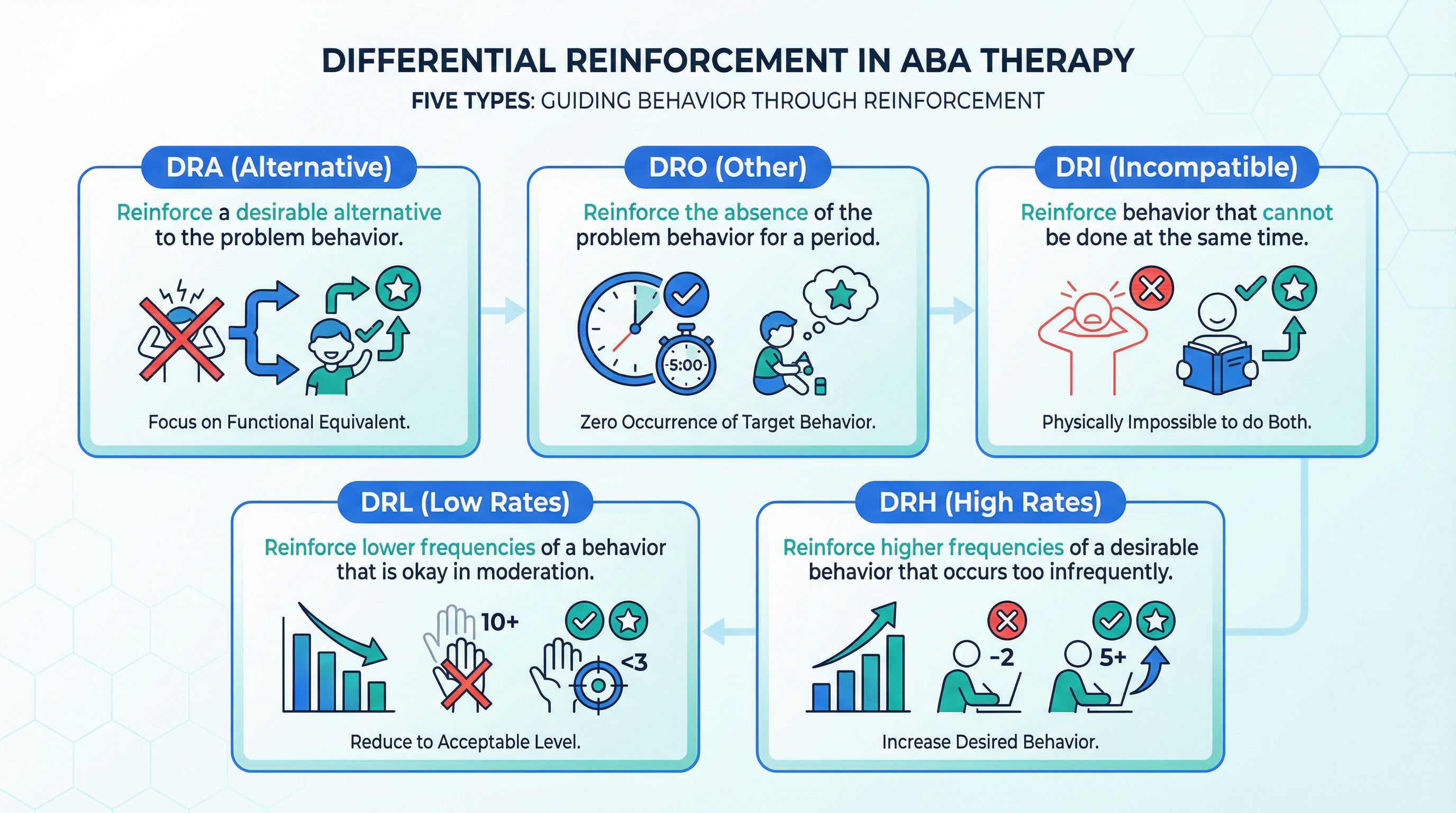
DRA: Differential Reinforcement of Alternative Behavior
DRA involves reinforcing a functionally equivalent alternative behavior while withholding reinforcement for the problem behavior. The critical requirement is that the alternative must serve the same function as the behavior you want to reduce.
Clinical example: A child screams to get a caregiver's attention. After conducting a functional behavior assessment (FBA), the BCBA determines the behavior is attention-maintained. The team teaches the child to tap the caregiver's arm and say "excuse me" instead. When the child uses the replacement behavior, the caregiver immediately provides attention. When the child screams, the caregiver does not respond.
DRA is the most commonly used differential reinforcement procedure and is often the primary intervention component of a behavior intervention plan (BIP). A systematic review by MacNaul and Neely (2018) found that DRA without extinction may be considered a promising practice for treating challenging behavior in individuals with autism.
Best for: Situations where a clear, teachable replacement behavior exists that serves the same function as the problem behavior.
DRO: Differential Reinforcement of Other Behavior
DRO reinforces the absence of the target behavior during a specified time interval. Unlike DRA, you are not reinforcing a specific replacement; you are reinforcing the learner for simply not engaging in the problem behavior.
Clinical example: A student blurts out answers in class an average of once every three minutes. The BCBA sets a three-minute DRO interval. If the student goes the entire three minutes without blurting, they earn a token. If they blurt, the interval resets. As the student succeeds, the interval gradually increases to five minutes, then ten.
Setting the interval: Use baseline data to determine how often the behavior currently occurs. If the behavior happens every three minutes on average, start with a three-minute interval. Starting with an interval that is too long sets the learner up for failure.
There are two main variations. Whole-interval DRO requires the behavior to be absent for the entire interval. Momentary DRO only checks whether the behavior is occurring at the exact moment the interval ends, which is easier to implement but less precise.
Best for: Situations where there is no obvious replacement behavior, or when the primary goal is simply for the behavior to stop occurring.
DRI: Differential Reinforcement of Incompatible Behavior
DRI reinforces a behavior that is physically incompatible with the problem behavior. The key distinction from DRA is that DRI behaviors cannot co-occur with the target behavior, while DRA alternatives could theoretically happen at the same time.
Clinical example: A child frequently leaves their seat during instruction. The BCBA reinforces sitting with feet on the floor. The child physically cannot be out of their seat and sitting at the same time.
Best for: Situations where a clear physical incompatibility exists between the desired and undesired behaviors. DRI is often simpler to implement than DRA because you do not need to identify the function of the problem behavior; you just need a behavior that makes the problem behavior physically impossible.
Limitation: Not every problem behavior has an obvious incompatible counterpart. In those cases, DRA or DRO may be more appropriate.
DRL: Differential Reinforcement of Low Rates of Behavior
DRL reinforces the behavior when it occurs at or below a set criterion. The goal is reduction, not elimination. This is the right choice when the behavior itself is appropriate but occurs too frequently.
Clinical example: A student raises their hand 30 times during a 40-minute class, disrupting the flow of instruction. The behavior is appropriate (raising a hand is good), but the rate is excessive. The BCBA sets a DRL criterion: the student earns reinforcement if they raise their hand 10 times or fewer during the class. As the student meets this goal consistently, the criterion decreases to 7, then 5.
Three DRL variations exist: full-session DRL (total count across the entire session), interval DRL (count within each interval), and spaced-responding DRL (requires a minimum time between each response).
Best for: Behaviors that are appropriate at low levels but problematic when excessive, such as asking questions, requesting help, or hand-raising.
DRH: Differential Reinforcement of High Rates of Behavior
DRH is the mirror image of DRL. It reinforces a behavior when it occurs at or above a set criterion. The goal is to increase the frequency of an existing but infrequent behavior.
Clinical example: A student rarely participates in group discussions despite having the skills to do so. The BCBA sets a DRH criterion: the student earns reinforcement if they contribute to the discussion at least three times per session. As the student consistently meets this goal, the criterion increases.
Best for: Increasing the rate of appropriate behaviors that already exist in the learner's repertoire but occur too infrequently.
Which Differential Reinforcement Procedure Should You Use?
One of the most common challenges practitioners face is choosing the right differential reinforcement procedure for a given situation. This comparison table and decision guide can help.
| Procedure | Goal | What Gets Reinforced | FBA Required? | Best For |
|---|---|---|---|---|
| DRA | Replace behavior | Functionally equivalent alternative | Yes | Clear replacement available |
| DRO | Eliminate behavior | Absence of target behavior | Helpful | No obvious replacement |
| DRI | Replace behavior | Physically incompatible behavior | Optional | Clear physical incompatibility |
| DRL | Reduce rate | Behavior at/below criterion | No | Appropriate but excessive behavior |
| DRH | Increase rate | Behavior at/above criterion | No | Infrequent appropriate behavior |
Decision guide: Start by asking what your goal is. If you want to replace a behavior and a physical incompatibility exists, choose DRI. If no physical incompatibility exists but you have a functionally equivalent replacement, choose DRA. If you want to eliminate a behavior and cannot identify a suitable replacement, choose DRO. If the behavior is appropriate but happens too often, choose DRL. If an appropriate behavior needs to happen more often, choose DRH.
How to Implement Differential Reinforcement: Step by Step
Regardless of which procedure you select, the implementation process follows a consistent framework.
Step 1: Assess the behavior. Conduct a functional behavior assessment to understand why the behavior occurs. This step is essential for DRA and helpful for all other procedures. Identify the antecedents, behavior, and consequences (the ABC pattern).
Step 2: Select the appropriate procedure. Use the comparison table above to match your clinical situation to the right DR procedure.
Step 3: Define your targets. Operationally define the problem behavior and, if applicable, the replacement behavior. Definitions must be observable and measurable.
Step 4: Choose your reinforcer. Conduct a preference assessment to identify reinforcers that are meaningful to the learner. The reinforcer for the desired behavior must be more motivating than whatever currently maintains the problem behavior.
Step 5: Set your criteria. For DRO, determine the initial interval length based on baseline data. For DRL and DRH, set rate criteria that are achievable at first. For DRA and DRI, ensure the learner can perform the replacement behavior before you start.
Step 6: Collect baseline data. Before implementing the procedure, collect at least three to five sessions of baseline data on the target behavior. This gives you a comparison point to measure your intervention's effectiveness.
Step 7: Implement consistently. Train all caregivers, teachers, and therapists involved. Inconsistent implementation across settings is one of the most common reasons differential reinforcement fails.
Step 8: Monitor and adjust. Collect ongoing data using frequency recording, interval recording, or trial-by-trial data depending on the procedure. Graph your data regularly. If the learner is not making progress within a reasonable timeframe, revisit your reinforcer selection, criteria, or procedure choice.
Common Mistakes to Avoid
Even experienced practitioners can make missteps with differential reinforcement. Here are the most frequent errors and how to avoid them.
- ✗ Skipping the FBA for DRA. If the replacement behavior does not match the function of the problem behavior, the intervention will not work. A child who screams for escape will not stop screaming just because you reinforce them for raising their hand (an attention-based replacement).
- ✗ Starting DRO intervals too long. If the behavior occurs every two minutes and you set a ten-minute DRO interval, the learner will almost never contact reinforcement. Start at or slightly below baseline levels.
- ✗ Using DRL when elimination is the goal. DRL is designed to reduce behavior, not eliminate it. If the behavior needs to stop entirely, use DRO or DRA instead.
- ✗ Reinforcing without teaching. Differential reinforcement is not a passive strategy. If you are implementing DRA, you need to actively teach the replacement behavior, not just wait for it to occur spontaneously.
- ✗ Inconsistent implementation. When caregivers, teachers, and therapists apply the procedure differently, the learner receives mixed signals. Ensure everyone on the team understands the protocol and applies it the same way across all settings.
- ✗ Not planning for extinction bursts. When pairing differential reinforcement with extinction, expect a temporary increase in the problem behavior before it decreases. Prepare caregivers for this pattern so they do not abandon the plan during the burst.
Differential Reinforcement and Your ABA Career
Mastering differential reinforcement is not just about passing the BCBA exam. It is a skill that directly impacts the quality of services you provide and makes you a more effective, more marketable clinician.
Employers consistently look for practitioners who can design and implement behavior intervention plans grounded in evidence-based procedures. Understanding how to select the right differential reinforcement procedure, pair it with teaching strategies, collect meaningful data, and adjust based on outcomes demonstrates the clinical judgment that hiring managers value.
If you are preparing for the BCBA exam, differential reinforcement falls under Task G.2 of the BACB 6th Edition Test Content Outline: "Design and evaluate differential reinforcement (e.g., DRA, DRO, DRL, DRH) procedures with and without extinction." Understanding these procedures in depth will serve you on the exam and throughout your career.
For a deeper look at how differential reinforcement fits into the broader clinical workflow, read our guide on creating behavior intervention plans. The FBA-to-BIP-to-intervention pipeline is where these procedures come to life in practice.
References
- Behavior Analyst Certification Board. (2024). BCBA Test Content Outline (6th ed.). BACB.com
- Kodak, T. & Clements, A. (2009). A review of recent studies on differential reinforcement during skill acquisition in early intervention. Journal of Early and Intensive Behavior Intervention, 6(4). PMC
- MacNaul, H.L. & Neely, L.C. (2018). Systematic review of differential reinforcement of alternative behavior without extinction for individuals with autism. Behavior Modification, 42(3). SAGE Journals
- Savage, M.N. & AFIRM Team. (2024). Differential reinforcement (DR): Evidence-based practice brief. UNC Frank Porter Graham Child Development Institute. AFIRM
- Vollmer, T.R., Roane, H.S., Ringdahl, J.E., & Marcus, B.A. (1999). An investigation of differential reinforcement of alternative behavior without extinction. Journal of Applied Behavior Analysis, 32(4). PMC
Highlight Your Clinical Skills to Employers
CertifyndABA lets you showcase specialized skills like differential reinforcement design, FBA, and data-driven intervention planning. Create your anonymous profile and let employers come to you.
Create Your Free Profile